
‘Knowing him was one of the great privileges of my life.’ John Wilson on Joseph Horovitz at 100
Share #RCMUpbeat
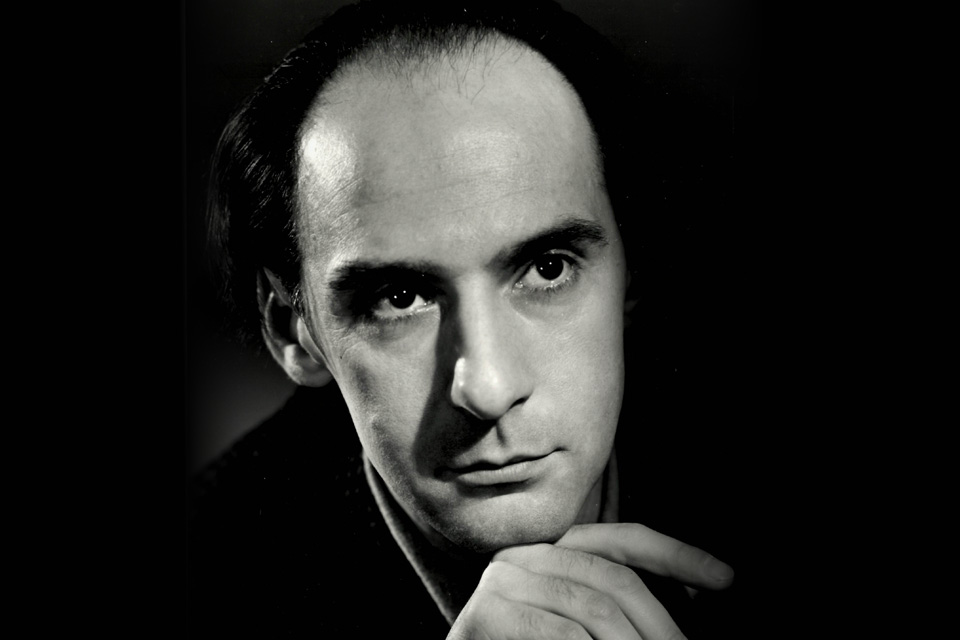
If there’s one Royal College of Music figure whose name crops up again and again, it’s composer Joseph Horovitz. To mark his centenary this year, Upbeat joined alumni and staff to find out more about this remarkable musician.
In almost every recent alumnus interview in Upbeat, Joseph Horovitz – often referred to, affectionately, as Joe – has been mentioned with enormous warmth. Composer Dani Howard recalled the time she found him in the College Library, aged 92, and asked him what brought him there. His reply: ‘I’m here to learn.’ He was the dedicatee of her work about her time at the RCM, The Butterfly Effect. Screen composer Alexandra Harwood admired the way Joe ‘pared back everything I thought I knew and built me up from scratch’. Composer Tony Britten described Joe as ‘a glorious man with whom I kept up till the end of his life.’
Tony Britten was among many colleagues and friends who gathered in the College’s wood-panelled Carne Room for a talk held to mark Joseph Horovitz’s centenary, and to launch the Library’s rich online resource about the composer – one of the largest composer archives housed by the RCM.
Several of those paying tribute got choked up remembering him. One memory shared was about Joe’s score to the series Wessex Tales. He plucked up the courage to write a letter to the BBC requesting they rerun the show. In that letter he wrote of his RCM protégés helping him to find the nerve to approach the organisation: ‘The students gave me the courage’.
Tributes were given by Librarian Peter Linnitt and Deputy Librarian Sarah Batchelor, before conductor and alumnus John Wilson spoke with RCM composition professor Kenneth Hesketh about their memories of Joseph Horovitz, and the impact he had on their lives.
[quote quote="He’s one of the two or three most profound influences on me in my life." author="John Wilson"]
[image1]
John Wilson on Joseph Horovitz
John Wilson knew he’d be a conductor from the age of 14 but could only enter the College as a percussionist. Composition was also suggested, and he was told, ‘you must meet Joseph Horovitz’. His response: ‘But he’s too famous!’ John recalls: ‘He put me at ease – and he didn’t talk about composition. From that moment I had someone on my side. He was a life raft. He refused to give up on his principles. He recognised that I wanted to be a conductor and cut me some slack – he was my music teacher; we had conversations about music. He’s one of the two or three most profound influences on me in my life.’
‘He understood that it was to write useful music that people wanted to play and hear and enjoy. He said, “I’m very glad I’m a perpetual student”. And he loved conducting, but composing always got in the way! He could also be quietly, devastatingly funny.’
‘I learned polish and finish from Joe. He was so detailed, discussing the exact duration of a pizzicato – it seemed fussy at first, but music is activated by that level of detail. Joe didn’t put pen to paper unless he had an inspired idea. There isn’t an ounce of fat on his music.’
‘I remember making the transition from student to friend – I called him Mr Horovitz until I graduated. He invited me to call him Joe – he introduced himself as though we were meeting for the first time. “I’m Joe, and this is my wife Anna.” After that I could just ring him up – and I got to conduct his music. I fell in love with his music. It’s always a great honour to conduct it, and I organised his 70th birthday concert as a tribute.'
‘I’m also performing his Violin Concerto. When I told him I wanted to perform the work he said no, it’s not finished. But we worked through the score together. I’ve still got the last page of notes he worked on at the end of his life – half-way down the page, the notes stop. But I absorbed so much of his way of doing things that I was confident in knowing what he wanted and completed the score. Knowing him was one of the great privileges of my life.’
Watch: John Wilson interviews Joseph Horovitz
[quote quote="I’ve still got the last page of notes he worked on at the end of his life. Half-way down the page, the notes stop." author="John Wilson"]
[image4]
Kenneth Hesketh on Joseph Horovitz
As a child, RCM composition professor Kenneth Hesketh loved Joseph Horovitz’s music without even realising it: aged nine he loved the album of King’s Singers lollipops called Romance and ‘played it to bits’, only realising much later that one of the highlights was by Joe. Ken played the tuba in a brass band, and attended the Royal Albert Hall premiere of Joe’s Ballet for Band. He was introduced to the composer at this time and thought, ‘if I’m lucky, I might see him again.’
Ken was partly drawn to study at the RCM by Joe’s presence, and spoke of ‘the incredible depth of his humanity – he was an island of love and calm. He really cared about what happened to his students’.
[image3]
Ken recalls Joe’s meticulous approach to teaching orchestration, including his examination of Ravel’s Boléro bar by bar. He also remembers Joe’s cosmopolitan flair and the care with which everything he wrote was realised, including his music for the screen.
‘The same breadth informed his teaching. He encouraged technical fluency, clarity of thought and rigorous self-criticism, but rarely sought to impose aesthetic allegiances upon his students. He was frank about the limits of pedagogy: if he could not discern a useful direction, or understand what a student wished to achieve, he would question whether he could help the student further. Yet where genuine artistic connection existed, teaching became an exchange from which he himself drew considerable nourishment.’
Ultimately, Joe advised Ken to ‘write what you want to. Write what’s authentic’. Ken elaborates on this principle: ‘Joe moved freely between musical worlds with a very practical, theatre-honed attitude – essentially, solve the musical problem at hand. I think that was very much part of what he passed on to his students.’
[quote quote="He was an island of love and calm. He really cared about what happened to his students." author="Kenneth Hesketh"]
[image5]
Staff memories
Sarah Batchelor (Deputy Librarian)
‘On one of my first days working at the RCM I was sitting on my own in a corner of the Senior Common Room at lunchtime, feeling shy as I didn’t know anybody. Joe came and sat with me; he asked me my name and just said, “Nice to meet you, I’m Joe”. This immediately put me at my ease and we had the first of what would be many hundreds of lovely conversations. It was only afterwards that I was told who he was. He was so kind and modest, and we were lucky to see him often, as he was always visiting the Library – he was eternally curious.’
[quote quote="'He asked me my name and just said, ”Nice to meet you, I’m Joe.” It was only afterwards that I was told who he was." author="Sarah Batchelor"]
Peter Linnitt (Librarian)
‘It was always a highlight for us in the Library when Joe came in. He was invariably kind, open and so generous with his time. Joe was one of the most curious people I’ve ever met. He once told me a day when he didn’t hear something new felt like a missed opportunity. His visits to the Library would see him borrow scores and CDs. When they were returned we would often have conversations about what he had been listening to. His views about the music were always insightful, he had a wonderful ability to articulate what was great about a work and also its flaws.
If you were lucky, Joe would tell you about the composers and musicians he had met. From Zemlinsky (when he was a child) to Stravinsky, of whom he was in such awe that he could hardly find it in him to speak!
When Joe talked about his own works, he was always conscious to refine how he presented them. His precision was at the service of the performers so they had the purest form of his music to work from. When he did discuss his archive, it was such an honour to talk to him about his life’s work – and also a huge responsibility.’
[quote quote="Joe was one of the most curious people I’ve ever met." author="Peter Linnitt"]
Read an overview of Joseph Horovitz’s life in this Upbeat feature.
Explore the Library archive.
Publications Officer Joanna Wyld is a writer and librettist who has written CD liner and programme notes for organisations such as the BBC Proms, Southbank Centre, Wigmore Hall and Salzburg Festival.