


Fellowship in Historical Keyboards
All fellows are expected to develop musical and communication skills by undertaking further intensive study, working with students internally and doing all they can to raise the profile of the RCM externally. They play a full and active part in the musical life of the RCM as well as functioning as RCM ambassadors. They have full use of the RCM Library with its wealth of material and work in close contact with the Creative Careers Centre, the RCM’s centre for professional skills and publicity services.
Current Fellow in Historical Keyboards
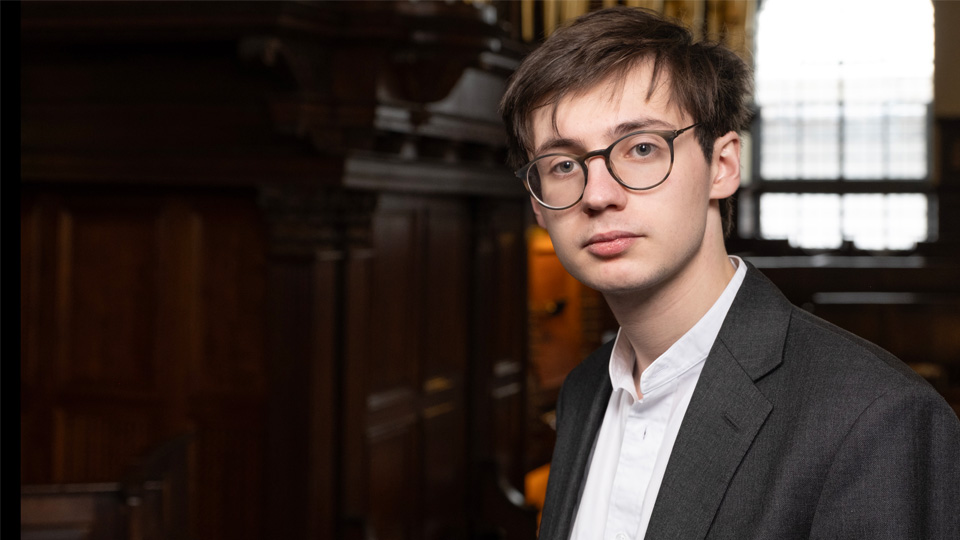
Luke Mitchell
Luke Mitchell is a prize-winning organist, harpsichordist and conductor, active across a repertoire spanning five centuries in a variety of fields. He is currently Fellow in Historical Keyboards at the Royal College of Music, where he plays, coaches and directs students in repertory spanning chamber music and madrigals to opera and oratorio. He is also Director of acclaimed ensemble The Duke’s Consort, with which he won the Nancy Nuttal Early Music Prize at the Royal Academy of Music. Specialising in repertoire of the late 17th century, they are currently Early Music Ensemble in Residence at the St Marylebone Festival, and in 2027 succeed the Gesualdo Six as a visiting Ensemble at the University of St Andrews, working and performing alongside students. He co-directs the St Marylebone Festival alongside Bertie Baigent, where he directs repertoire from Blow, Monteverdi and Locke to Pärt, Rachmaninoff and Tavener, and from 2022-2024 was Studio Director of New Chamber Opera, Oxford.
As a Historical Keyboardist, he won 1st Prize in the Harriet Cohen Early Keyboard competition held by The Musicians Company, and recently curated a Bach series at New College Oxford. He has appeared as a concerto soloist and director at the London Handel Festival, Keble Early Music Festival and St Marylebone Festival, and has enjoyed working with several leading ensembles, including The Sixteen, Instruments of Time and Truth, The Academy of Ancient Music and Contrapunctus. As a Harpsichordist he is in demand as a collaborative recording artist and chamber partner, and appears regularly with violinist Verena Eggensberger across the country.
He maintains a parallel career as an Organist and Church Musician, and is currently Assistant Director of Music at St Marylebone Parish Church, and recently spent a year as Organist of Exeter College, Oxford, and prior to his studies was Organ Scholar of Worcester Cathedral, winning a performance prize from the Royal College of Organists As an Organ Recitalist, recent performances have included Westminster Abbey, St Paul’s Cathedral, and Grosvenor Chapel for the Royal College of Organists, as well as all-Bach programmes for the St Alban’s International Organ Festival and Oxford Philharmonic, with a forthcoming recital on the new organ at St John’s College, Cambridge. He regularly improvises in concert, both freely and in historical styles, and is currently preparing new transcriptions of Orchestral Works by Wagner and Debussy.
He read Music at The Queen’s College Oxford as an Organ Scholar, winning the Boise Scholarship for Performance in his Final Year. He also held parallel scholarships with New Chamber Opera, and a conducting scholarship with the University Schola Cantorum. Whilst at Oxford, he played in all the major recital series, appeared multiple times live on BBC Radio 3, and toured and performed extensively with the renown choir at Queen’s. Whilst at Oxford, he studied Organ with Stephen Farr, Conducting with Paul Spicer and Owen Rees, and Harpsichord with Laurence Cummings. He completed a Masters in Historical Performance at the Royal Academy of Music in London, where he enjoyed regularly working with guest conductors both as a continuo player and in singer preparation. He continues his studies with Carole Cerasi and James Johnstone.
The Fellow in Historical Keyboards receives a tax-free bursary for which they carry out activities including musical work specifically designed to improve and widen their skill sets. Their commitments include being involved in RCM activities, including receiving guidance and informal tuition, and practice time on keyboard instruments provided by the RCM. Bursaries are intended to supplement, not replace, contributions from applicants' own resources.
Applicants from outside the UK should note that they are required to indicate on their application what evidence they can show to prove their right to be in the UK for the duration of the fellowship.
The Fellow in Historical Keyboards is responsible for arranging their own lessons and other tuition. Tuition may include lessons with RCM professors or those not directly associated with us. Fellows are also responsible for planning their own work routines and monitoring their effectiveness. Funds may also be used for tuition in related areas of study, such as coaching on other areas of repertoire, language study, related instruments and costs associated with starting out in the profession.
The Fellow in Historical Keyboards is required to accompany one-to-one lessons, faculty classes, examinations and others as agreed with their relevant Head of Faculty. Accompaniment is likely to be in the region of 540 hours over the year, primarily during the RCM’s 30 teaching weeks.
The Fellow in Historical Keyboards will report to the Head of Keyboard and to the Projects Manager, but also to the Head of the Faculty to which they are assigned.
You will be required to:
- Lead, coach, direct, inform and work with RCM performers and composers
- Provide advice, contacts, and examples of career development which should help current students
- Accompany for the faculty to which you are assigned but also be able to accompany for all faculties as required
- Liaise with and give support to the Head of Keyboard, and the Head of the faculty to which assigned and the Pathway Leader for Postgraduate Accompaniment
- Act as duo partner for students in concerts, prize competitions, faculty and guest masterclasses and examinations.
- Be a member of the team of Accompaniment Fellows, giving support to others, attending regular Fellowship meetings and contributing to wider events
- Live in Greater London and be based at the RCM and normally be on site at least four days a week in term time
- Organise and/or become involved in projects and activities which enable you to work with current RCM students
- Participate in the organisation of and attend the annual Fellows’ evening
- Attend special events as RCM representatives, contributing to these as requested
Applicants should already have successfully completed formal studies at a level equivalent to a postgraduate diploma or degree or be completing these studies in the academic year in which the application is made. Applications will be considered from those with equivalent experience.
It is preferred that your existing formal studies have included specialism in harpsichord and/or continuo.
Applicants need to be able to demonstrate:
- Wide experience of harpsichord and/or continuo accompaniment work
- Excellent proficiency in sight-reading
- Considerable collaborative skills
If you are not a UK resident, you must obtain permission to be in the UK from the UK Border Agency in order to hold a fellowship. Accompaniment Fellows are not eligible to hold or extend student visas. An option currently available for fellows who are not UK nationals is the Youth Mobility Scheme.
Find out more about the Youth Mobility Scheme
These conditions are set by the UK Government and can change. Please ensure you visit their website for the most up-to-date information.
Applicants are required to submit a portfolio supported by a letter of application, which should indicate your suitability for the fellowship and your readiness to present yourself as an emerging professional.
Your application should contain:
- Letter of application addressed to the Director, including confirmation of permission to be in the UK and stating clearly that you wish to apply for a Fellowship in Historical Keyboards
- Curriculum vitae and biography of c200 words
Find out more about portfolio contents
Submitting your portfolio
You should submit your portfolio online using a single combined PDF through the RCM submission portal. The information you upload to the portal does not constitute your entire application, but does form an integral part of it. You should ensure you have provided everything that is required. Incomplete applications may not be considered.
When using the submission portal you will be asked to create a user name and password, and to provide an email address. You should select 'junior fellow' from the list of programmes and the Historical Keyboard Fellow programme. There are no restrictions to the file size or type.
If you experience any problems uploading your portfolio please contact Lauren Pountney.
Lauren Pountney
Assistant to the Deputy Director, Artistic Director, and Fellows' Administrator
020 7591 4370
If you are selected for the second stage, you should be prepared to discuss your application in further detail at interview. You are advised to keep a copy of whatever you submit.
Shortlisted applicants will be invited to attend a sight-reading audition and an interview with the Director and the Head of Historical Performance.
Should you be invited to interview, you will be required to bring original documentation (visa, passport or leave to remain in the UK) confirming that you have permission to be in the UK.
In your interview you will be required to:
- Meet and talk with a panel
- Discuss the contents of your portfolio and your achievements to date
- Expand on any of the information in your portfolio in light of developments since applying
- Discuss experience and career plans and suggest ways in which you would like to contribute to the work of the RCM
- Sight read two pieces, lasting in total no more than fifteen minutes’ playing time. In one of the pieces you will be accompanying a soloist. You will be given a copy of the music and will have access to a practice room to rehearse this for 20 minutes before the audition. You will then perform the piece with a soloist who will be provided by the College, and who will be familiar with the work. The second piece will be completely unseen and will be given to you during the audition
Results will be conveyed as soon as possible after the interviews have taken place.
Auditions and interviews will be held at the Royal College of Music in London.
As a Fellow you will be expected to:
- Include reference to the award in your CV and in any biographical notes accompanying appearances
- Produce a short written report on activities undertaken to date by the end of each term
- Keep trustees and sponsors informed on a regular basis of opportunities to attend performances or events in which you are involved
- As for all those associated with the College, to adhere to and uphold the College’s values and policies as detailed on our strategies and values pages
The RCM’s internal awards and competition funds are not available to Historical Keyboard Fellows. It is possible to take part in competitions as an accompanist or an ensemble member, but fellows may not receive any prize money, which is only awarded to registered students. This restriction includes concerto competitions as soloist. RCM awards and Access Funds are similarly unavailable.
Fellows are encouraged to support other students, particularly as accompanists, but may not perform as soloists in any of the regular chamber concerts. As part of the terms of the Fellowship, there are various special events, within the RCM and outside, in which Fellows are expected to take part, without additional payment.
Royal College of Music
Prince Consort Road
London SW7 2BS
United Kingdom
Registered charity No. 309268